Hot Weather Concrete in Colorado: Why Fast Isn’t Better
Learn how Colorado’s heat, low humidity, elevation, and wind affect concrete curing, and discover the professional techniques used to prevent cracking, discoloration, and premature concrete failure.
6/17/20264 min read
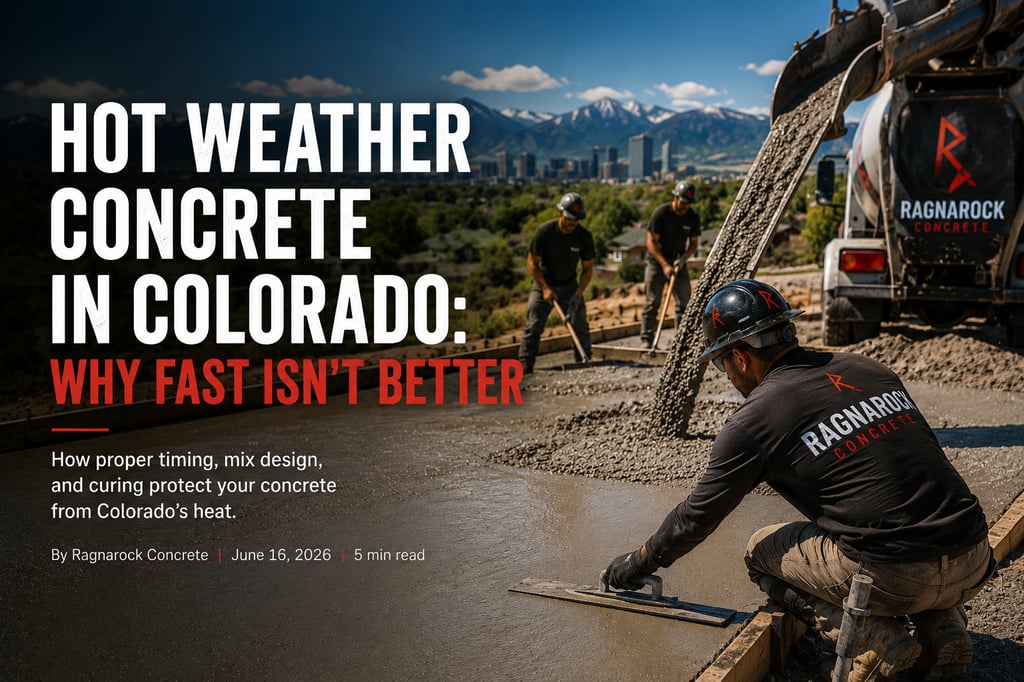
Hot Weather Concrete in Colorado: Why Fast Isn't Better
By Ragnarok Concrete | June 16, 2026 | 5 min read
Colorado summers look perfect on paper. Clear skies, warm mornings, and a calendar full of outdoor projects. But for concrete contractors, summer heat is not an advantage. It is a variable that has to be controlled, or the finished slab will show you exactly where things went wrong.
Here is what most homeowners do not realize: concrete does not dry. It cures. Those are two completely different processes, and confusing them leads to expensive mistakes.
The Myth of Faster Drying in Summer
One of the most common misconceptions in residential concrete work is that hot weather speeds things up in a useful way. It does speed things up, but not the part that matters.
Concrete gains strength through a chemical process called hydration, where water and cement react over time to form a hard, dense matrix. That process needs moisture to work. When surface moisture evaporates too fast due to heat, sun, dry air, or wind, hydration is interrupted before the slab has reached its design strength.
The results are visible and costly:
Plastic shrinkage cracks form within the first few hours of placement.
Reduced compressive strength means the slab never reaches its rated PSI.
Surface scaling and dusting cause the top layer to weaken and degrade prematurely.
Discoloration and blotchy finish are especially damaging on stamped, stained, or exposed aggregate work.
For a standard gray driveway, these issues are frustrating. For luxury decorative concrete, they are project ending.
Why Colorado Makes This Harder Than Most States
Colorado's climate creates a uniquely hostile environment for summer concrete work. The combination of high elevation, low humidity, intense UV exposure, and afternoon wind produces some of the highest evaporation rates in the country.
The American Concrete Institute uses an evaporation nomograph, a calculation that accounts for air temperature, concrete temperature, relative humidity, and wind speed, to determine when a pour is at high risk. In Colorado's Front Range during summer, that threshold is frequently exceeded even in the morning hours.
Here is what makes Colorado specifically difficult:
Elevation at 5,000 to 5,500 feet in the Denver metro means lower atmospheric pressure, which accelerates surface drying faster than at sea level.
Afternoon wind patterns are common across the Denver metro, particularly along the foothills, and dramatically increase evaporation rate during finishing.
Dry air puts Colorado among the lowest average relative humidity readings in the lower 48 states.
Intense solar radiation means UV index readings regularly reach 10 or above during summer months.
These are not worst case scenarios. They are Tuesday afternoon in Cherry Creek.
How Ragnarok Concrete Controls the Variables
Producing high quality concrete in hot weather is not a matter of working faster. It is a matter of controlling every variable in the process before, during, and after the pour.
Timing the Pour
Work begins early. Morning pours, typically before 8 a.m., allow the critical placement and finishing phases to happen before peak heat arrives. Concrete placed in cooler morning conditions has more working time, better workability, and a significantly lower evaporation risk during the first hours of set.
Base Preparation
A dry or hot subbase will aggressively pull moisture from the bottom of the slab while the sun attacks the top. Before placement, the base is dampened, not saturated, to neutralize this effect. Formwork and adjacent surfaces are also pre-wetted when conditions require it.
Mix Design for Conditions
Hot weather is not the time for a standard off the shelf mix. Adjustments are made based on actual site conditions on the day of the pour:
A reduced water to cement ratio maintains strength without excess bleed water.
Set retarding admixtures extend working time without sacrificing long term strength.
Chilled mix water or ice substitution lowers the concrete's initial temperature before placement.
Reduced haul time minimizes heat gain during transport from the plant to the site.
Rapid and Coordinated Placement
Once concrete is on site, the window is short. Experienced crews place, consolidate, and strike off quickly and in sequence, without rushing the finish prematurely or overworking the surface. Every minute of delay after delivery adds risk.
Curing: The Step That Determines Everything
Curing is where the difference between a durable slab and a problem slab is made. For decorative or high specification work, curing options include:
Curing compounds sprayed immediately after finishing to seal in surface moisture.
Wet curing using burlap or cotton mats kept continuously moist for seven or more days.
Plastic sheeting used for flatwork to trap moisture and moderate temperature swings overnight.
Evaporation retarders applied during finishing in high wind or high heat conditions.
The American Concrete Institute recommends a minimum curing period of seven days for standard concrete, and longer for decorative work. Skipping or shortening this phase is where the majority of hot weather failures originate.
What This Means for Your Project
If you are planning a concrete driveway, patio, pool deck, or exterior living space in the Denver metro area this summer, the most important question to ask your contractor is not about price. It is about how they manage hot weather conditions.
A contractor who says summer is fine without describing their specific process is one worth pressing harder, or walking away from entirely. Luxury decorative concrete done right in Colorado summer requires planning, experienced crews, the correct mix design, and disciplined curing. Done wrong, the damage is often irreversible without full removal and replacement.
Built for Colorado. Built to Last.
At Ragnarok Concrete, every pour is scoped for actual conditions, not ideal ones. That means accounting for the elevation, the dry air, the afternoon sun, and the specific demands of the finish you have chosen. Whether it is a stamped patio in Parker or an exposed aggregate driveway in Cherry Creek, our process is engineered to produce a slab that performs as well in year five as it looks on day one.
Ready to start your project? Contact us for a consultation and site evaluation.
Call or text: 720.701.3089
Email: info@ragnarockconcrete.com